geology

Showing posts with label rigs. Show all posts

Friday, 11 November 2011

gold in sudan

Processing Gum Arabic


Introduction:

Gum Arabic is one of the most important cash-generating export crop in Sudan. It is one of the best of its type in the world. The project aims at processing gum Arabic, locally, to improve exports and benefit from the value-added.
- The sites producing gum Arabic in Sudan:

- Kordofan region 49.3%

- Kassala region 24.4%

- Darfur region 23.4 %

- White and Blue Nile region 2.9%

- The proposed sites for erecting the project:

Near the production collection regions.

- The productive capacity: 4000 tons per year.

- Methods of gum Arabic processing:

- The mechanical method.

- The method of sprinkle drying.

- The mechanical Method:

- Preliminary cleaning unit.

- Air cleaning and sorting unit

- Breaker.

- Refining mill and granules production mill.

- Conveyor belts.

- Packing unit with weighing machine.

- Quality control laboratory.

- Electrical control panel.

-The sprinkle Drying Method Equipment

- Dissolving container.

- Sifters with various openings.

- Sedimentation cylinder and the solution concentration cylinder.

- Drying and spraying unit.

- Cylinder drying unit.

- Solar energy unit for heating water.

- Cleaning and sorting unit.

- Quality control laboratory.

Area : Estimated at 800 m2 ; as follows:-

144 m2 Production hall.

280 m2 First cleaning shed.

48 m2 Second cleaning shed

250 m2 Stores

75 m2 Offices + utilities

Invested capital : US $ 6.628.032

Operating capital : US $ 192.247

Fixed Assets : US $ 150.735

Net profits : US $843.561

Profitability : 10 %


Period of Re-imbursement : 2 years


Raw Materials : gum Arabic – packing materials (Jute sacks)


Contact Address:


Investment Department,


Federal Ministry of Industry


Tel : 0249183777770


The Processing of Basic Chlorine


Introduction:


The Sudan is distinguished by its Red Sea shore, which provides salt. This encourage the establishment of a basic chlorine plant for the production of the following:-


- Caustic Soda: which is used in numerous industries, such as, textiles, industrial detergents, soap, edible oil refining and other industries which benefit from the characteristic of bleaching of the caustic soda.


- Chlorine: Which is used in many fields; such as, the water purifying and sterilization networks, the sewerage system networks and several other uses which benefit from the characteristic of chlorine as a disinfectant and insecticider.


- Hydrochloric acid (HCL): which is widely used as a multi-purpose acid. It is also used in large quantities for purifying the calcium carbonates from the bottom of oil wells and in petroleum refineries.


- Sodium hypochlorine: Which is used in the Weaving and spinning industry; and other purposes which benefit from its characteristic as a bleacher and pesticider.


- Productive capacity:


· Caustic soda 5 tons/day.


· Chlorine 5 tons/day.


· Hydrochloric acid 5 tons/day.


· Sodium Hypochlorine 5 tons/day.


- Invested capital US $ 2.700.000


- Raw materials:


- Sodium chloride.


- Phosphoric acid.


- Soda dust.


- Hydrochloric acid.


- Electricity.


- Man-power:


35 (direct and direct labour).


- Area of plant: 6560 m2.


- Location : It is preferred that the project shall be close to salt sources (i.e. Eastern Sudan.).


- Project’s Product users:


- Edible oil plants..


- Petroleum fields.


- Weaving and spinning plants.


- Water distribution networks.


- The average imported amounts during the last three years:-


2000 tons


- Contact Address:


The Investment Department,


Federal Ministry of Industry,


Tel: 0249 183 777770


Assembly and manufacture of


Solar Energy Equipments


Introduction:


God endowed the Sudan with a climate of less clouds and much sunshine throughout the year, therefore the Sudan is considered an ideal place for the system of transferring the light of the sun to electricity.


The Invested capital: 673653000 Sudanese Dinar


Machineries and Equipments:


- Assembly of Solar cells.


- Liquid batteries.


- Tools and Equipments.


Total cost of Machineries and Equipments:


122,000,000 Sudanese Dinar


Cost of raw materials for One Operational year:


150,000,000 Sudanese Dinar


Recovery Period: Two years


Contact Address:


Department of Investment ,


Federal Ministry of Industry


Tel: 0249183777770


Calcium Carbonate Manufacture


Introduction:


The lime stone is composed of the matter of calcium carbonate which could be grinded and purified for the extraction of pure powder of calcium carbonate, which is used in filling the plastic pipes and the plastic utensils, and also it is used in the production of insecticides and tooth paste, in addition to its use in cultivation and animal husbandry.


The proposed productive capacity: 20 ton/day.


The Investment Capital: 1,500,000 US Dollar.


The raw materials: Lime stone


The volume of employment: 450 direct and indirect employees.


The establishment area: The total area of the project is 35,000 m2.


The Location: It is preferable to establish the project near the areas where the raw materials are available and they are: Gabalain province, ‘Gabalain ‘town’ Atbara town, Sennar, Jabal Marra and any areas where the lime stone is discovered.


The Users of the Production:


- Plastic pipes production Factories.


- Plastic house utensils production Factories.


- Insecticides poweder production factories.


- Tooth paste production factories.


- The farmers.


Average of the Imported quantities during the last three years:214tons


Contact address: Investment Department:


The Federal Ministry of Industry,


Tel: 0249183777770


Concentrated Feed Manufacture


Introduction: The concentrated feed are protein and hydrocarbonic materials produced from the agricultural and processing remains and they wore divided into:


(a) Animal feed: They use the residues of legumes. Couch grass straw, Durra reeds, rice straw, residues of oil seeds like cotton seed, peanuts husks sesame sunflower, beans and the retuse of sugar factories such as Mollas, bugas and cane heads.


(b) Poultry feed: Contains fish powder, meat and bones powder and other animal remains like blood in addition to some materials used in Animal feed.


The targeted market: To cover the local market and exportation to the African and Arab countries.


The Productive capacity:


The proposed: 15,000 ton/year


The invested capital: estimated USD 1,550,000


The raw materials: Oil cake of cotton seed, wheat bran, bugas, Molas, pea-nuts husk, Dhura stalks, Calcium carbonates,


Table salt and vitamins.


The Premises area: 2200 m2


The Working force: 35 direct and indirect workers.


Average of imported quantities during the last three years:3503tons


Contact Address: Investment Department


Federal Ministry of Industry.


Tel : 0249183777770


Gold Processing Project


Umm Nyardi Mine


Location: North Wadi Half town


Annual Mining Capacity:


The Project target the mining and processing of 700 Kilograms annually.


Investment Costs: about USD 90 millions, Annual costs of production. USD 2.5 millions.


Annual Sales Returns: USD 7 million, net profits : USD 4.5millions.


Financial indicators: Net profits ratio to sales : 64%


Capital Recovery Period : about two years.


Contact Address: Investment Department


River Nile State


Tel : 0211822557


Glass Production Project


Location of the Project: Mattama Area


Mining capacity: 150 ton/per day


Project sales returns : Amounts to 17,4 million us Dollar.


Annual Production costs for the entire project:


Amounts to 9.1 million us Dollar


Financial indicators: Net profits ratio to the sales: 52%, Net profits ratio to the investment 37%


Capital recovery period: Two years


Contact Address: Investment Department


River Nile State.


Tel : 0211822557


Iron Extraction Project


The proposed Location: Bigrawiyya area


Raw materials: The raw iron belt which was formely expolcted by the pharaohs exist in the Bigrawiyya belt area with quantities not less than

750 million tons.


The targeted productive capacity: amounts to USD 100 millions.


Annual cost of production: amount to USD 362 million


Sales returns: amounts to USD 550 million


Annual net profits: amount to USD 100 million.


Financial indicators:


Net profits ratio to Sales : 34%


Net profits ratio to investment : 100%


Capital recovery period: One year


Relative advantages of the project: Electricity is considered the principal element in the costs of production as the project needs annually 3000 megawatt/hour.


The establishment of Kajbar reservoir will make available the electrical energy to this project.


Note: The establishment of the project requires the execution of geological surveys to determine the reserve volume.


Contact Address: Investment Department,


River Nile State:


Tel : 0211822557


Ceramic and Porcelain Production Project


Location of the project: South Matamma.


The targeted productive capacity:


The project aims to produce 3,000 m2 annually.


Cost of Investment: The volume of the required investment is estimated around 31,7 millions US Dollar.


The return of the project’s annual sales: 63 million US Dollar.


Costs of Production: A sum of 48,9 million US Dollar.


Annual net profits: 14.1 million US Dollar.


Financial indicators:


Net profits ratio to sales : 17.4


Net profit ratio to investments : 32.2%.


Internal return average : 39.6%


Capital Recovery Period: 3 years


Contact Address: Investment Department


River Nile State,


Tel: 0211822557


Cement Production Project


The proposed Location: Five factories will be established as follows:


· Two factories in west Berber area.


· One factory in Abu Hamad area.


· One factory in Ebiediyya area.


· One factory in Atbara town.


The designed productive capacity for each project:


Each project aims to produce 325,000 ton cement/year.


Investment for each project:


The Total investment cost: 55,1 million US Dollars.


The annual project sales, ‘ for each project’.


The project gross return when it works with full capacity:


29.2 million US Dollar.


Annual cost of production: 10.2 US Dollar.


Annual total profit for the project : 19 million US Dollar


Financial Indicators:


Net profits ratio to the Sales = 65%


Net profits ratio to the investment = 35%


Period of capital Recovery: Three year


Contact Address : Investment Department,


River Nile State


Tel : 0211822557


Mica Production Project


Location of Project: El-Shriek – River Nile State


Targeted productive capacity : 200 ton/day.


Investment Costs : 2.5 million US Dollar.


Annual Sales return : 1.2 million US Dollar


Costs of Production: 0.6 million US Dollar.


Net profits ratio to the Sales = 34%


Net profits ratio to the investment = 100%


Capital recovery period: 3 years


Contact Address : Department of Investment


River Nile State


Tel : 0211822557


http://www.sudaninvest.org/English/Projects-Industry.htm

Monday, 25 July 2011

UK airports flight information: Volcanic ash latest

UK airports flight information: Volcanic ash latest

Tuesday, 24 May 2011


Passengers wait with their luggage at Glasgow Airport (PA)

The European air traffic agency Eurocontrol said that between 200 and 250 flights have been cancelled in Europe.
 The disruption is expected to spread to some northern England airports later today.

The eruption of the Grimsvotn volcano has already led to airlines cancelling a number of flights to and from Irish and Scottish airports.

 Shortly after 9.30am today, air traffic control company Nats said "an area of volcanic ash" was forecast to affect some parts of the UK between 1pm and 7pm today.

 Nats said airports remained open but that services from Londonderry, Glasgow, Edinburgh, Prestwick, Newcastle, Carlisle, Durham Tees Valley and Cumbernauld airports may be affected.

Nats said passengers should check with their airline before travelling to these airports.

The airports listed by Nats could all possibly experience high- level densities of ash.
Earlier Nats had said air services at Aberdeen, Inverness, Benbecula, Barra and Tiree airports could be affected until 1pm. The latest bulletin from the company suggested that these airports might be free of ash later today.

In the meantime, airlines have already axed many flights to and from Scotland, with British Airways not operating any flights between London and Scotland before 2pm.
Scots regional airline Loganair scrapped 38 flights and Irish carrier Aer Lingus said it had cancelled 12 flights to and from Glasgow, Aberdeen and Edinburgh.
British Airways announced that it would not operate any flights between London and Scotland before 2pm.
EasyJet also cancelled its flights from Glasgow until lunchtime.
At Glasgow today, most passengers whose flights had already been cancelled did not make their way to the airport.
Passengers with holiday companies Thomson and Thomas Cook were waiting for buses to take them to Manchester to pick up later flights.
The airport's cafes were packed and people sat on their suitcases or tried to catch up on sleep as they waited for news.
Guy McKinven, from the Clyde Valley area, was travelling with easyJet to Stansted to spend a week with his grandmother.
He said: "You see people shouting and getting upset, but there's nothing you can do.
"It is frustrating, but that's just the situation. EasyJet have been helpful and have told me I can have a refund for my flight.
Despite the flight cancellations today, there were hopes that the latest crisis would not have the same devastating impact as last year's Icelandic volcanic eruption which saw UK airspace shut down and thousands of air services axed.

Transport Secretary Philip Hammond said: "There is some early indication that the scale and power of the eruption might be subsiding a little bit.
"Perhaps it's a little bit too early to be absolutely sure about that, but clearly that's the most important thing. If the ash stops belching out of the volcano then, after a few days, the problem will have cleared, so that's one of the factors.
"The other is the wind speed and direction. At the moment the weather patterns are very volatile which is what is making it quite difficult, unlike last year, to predict where the ash will go."
He added that the public should be assured that airlines would only operate when it was safe to do so.
Ryanair said it carried out a one hour flight 41,000ft over Scotland this morning in the so-called "red zone" of the ash cloud from Glasgow Prestwick to Inverness, on to Aberdeen and then south to Edinburgh.

Aviation chiefs have deemed Scottish airspace "high ash concentration".

Ryanair said there was no visible volcanic ash cloud or any other presence of ash and post flight inspections revealed no evidence of ash on the airframe, wings or engines.

The low-cost carrier claimed the red zone was non-existent, mythical and a misguided invention by the UK Met Office and the Civil Aviation Authority (CAA).

Ryanair said it has written confirmation from both its airframe and engine manufacturers that it is safe to operate in the area.

"This morning's verification flight has demonstrated that the UK Met Office's 'red zone' forecasts are totally unreliable and unsupported by any evidence of volcanic ash concentrations whatsoever," Ryanair said.

Read more: http://www.belfasttelegraph.co.uk/news/local-national/northern-ireland/uk-airports-flight-information-volcanic-ash-latest-16003692.html#ixzz1TAcgSE19

Monday, 6 June 2011

supervisor Geologist Questions


Geology Questions?

BASIC CONCEPTS OF GEOLOGY

1. How long ago was the oil being extracted today formed?


The oil was roughly formed between 30 to 500 million years ago


2. Where do you find oil or gas in rock underground?


We find them in pore or fracture of rocks


3. What are the common reservoir rocks?


There are sandstone, limestone and dolomite


4. What sort of rocks are they?


They are mostly sedimentary rocks


5. What is meant by a trap?


A trap is a underground formation which prevent the escape of oil and gas contained in reservoir rock.


6. What is a cap rock?


Cap rock is non-porosity and impermeable to the fluids bellow


7. Do you think overburden pressure can force the reservoir fluids through the cap rock and up to surface if a hole is drilled through the cap rock?


Yes


8. How do oilmen know where to drill?


Generally speaking, that is the job for the petroleum geologist.


9. how can petroleum geologist locate the position where oilmen are to drill?


Petroleum geologist can use the result of seismic surveys (or even aerial surveys) to get information about rock features beneath the surface


10 when and how was the earth originated?


The earth is though to have originated some four to five billion years ago by condensing out of a cloud of cosmic dust.


11.what is the origin of igneous rocks?


Igneous rock is solidified from molten form called magma.(molten melt)


12.how many kinds of rocks have been considered so far?


Three kinds


13.what are they ?


they are igneous rock, sedimentary rock and metamorphic rock.


14.if metamorphic rocks are subjected to even more heat, they may be melted and become magma rocks, do you agree?


Yes ,I agree. (ignore and igneous inflame)


15.among igneous rocks, metamorphic rocks and sedimentary rocks, which one is more important to petroleum geology?


Of course,the sedimentary rock is more important than the rest.


16.why?


because most oil and gas accumulations occurs in sedimentary rock.


phenomenon appearance phenomena


17.where can we see some samples originally deposited in an ancient sea?


Some remains of marish shells can be found in some hightest mountains and in deepest oil wells.


18.what is the most common kind of deformation?


The most common kind of deformation is the buckling of the layers into a fold.


.are folds the most common structure in mountain chains


yes ,folds are the most common structure both in present and former mountain chains.


20.what are anticlines?


Anticlines are upfolds or arches structure of the mountain chains.


21.and synclines?


Downfolds or troughs are synclines.


22.Folds, usually,have only one form, is that right?


No. folds have many forms.


23.folds are often symmetrical, are not they?


yes and no. they may be symmetrical or asymmetrical


24.how do you describe faults?


Faults are described according to their present attitude by various names.


25.how many kinds of faults are classified?


There are four kinds of faults.


26.what are they ?


they are normal,reverse,thrust and lateral.


27.what are rotational faults and upthrusts?


Rotational faults and upthrusts are variations of normal and reverse faulting.


28.how many kinds of oil seeps are there in petroleum geology?


There are two general kinds.


29.what are these two kinds of oil seeps?


Seepage up --dip and seepage along fractures.


30.are there any other geophysical methods used to find suitable structure for petroleum accumulation?


Yes ,there are.


31.could you tell me what these methods are?


We can find favorable structures for petroleum accumulation using gravimeter and magnetometer .


32.what is porosity?


Porosity is a measure of the pore space in the body of reservoir rocks, usually expressed as a percent of a void space per unit volume of rock.


33.what is permeability?


Permeability is a measure of ease with which a fluid flows through the connected pore spaces of a reservoir rock.


34. is it important to predict sand trends in exploiting sandstone reservoirs?


Yes ,but not only the prediction of sand trends but also the prediction of pore space distribution.


35.What is needed to get a petroleum accumulation ?


there are three points in dealing with the question.


36.what is the first point,please?


Firstly ,there must be a source of oil and gas.


37.and your second point?


Secondly,the existence of a porous bed which is permeable enough to permit the oil and gas to flow through it the reservoir rock.


38.and the last one .


a trap ,which is a barrier to flow fluid so that accumulation can occur against it


39.where did oil and gas originated ?


oil and gas originated from decayed organic matter in sedimentary rock.


40.What does the word “migration”mean in petroleum geology?


After generation ,the dispersed hydrocarbons in the fine grained source rocks must be concentrated by migration to a reservoir。Such a process is called migration 。


41.How are the driving forces behind migration ?


the driving forces behind migration are provided by the weight of the overlying rocks,circulating of groung water and gravity。


42.What are those forces behind migration?


The driving forces are the forces necessary to expel the hydrocarbons and to move them through the more porousbeds or fractures to regions of lower pressure.


43.Do you think gravity plays some part in the migration ?


yes ,gravity plays a role of separating gas ,oil and water。


44.What about the distribution of fluids in a reservoir rock?


The distribution of fluids deponds on their densities and on the capillary properties of the rocks。


45.If a reservoir rock contains uniform pores,and if the pore are evenly distributed,what will the distribution of fluids be like in a trap, then?


In this case ,there will be three zones of fluids in the trap。


46.What are the three zones in a trap ,please?


An upper zone( or gas cap) ,a middle zone and a lower zone .


47.What are contained in the three zones respectively?


The rock pores in the upper zone are filled mainly by gas.


48.And the middle zone and the bottom zone?


The middle is filled mainly by oil and gas in solution and the lower water


49.Is there any water in the middle zone?


A certain amount of water always occurs together with oil in middle zone。


50.What is the usual proportion of water to oil in the middle zone?


The proportion of water to oil is usually from 10 to 30 percent。


51.Does water occur in the gas cap?


Yes ,it does.but the proportion of water to gas is frequently lower than the proportion of water to oil.


52.Is there a special name for the water found in the oil and gas zones?


Yes,there is。It is called “interstitial water”or“connate”


53.Does the crude oil in a trap contain natural gas in solution under pressure?


Yes ,it does. It is the local pressure and temperature conditions that keep the gas in solution with the oil.


54.How does the natural gas come from crude oil?


It is quite simple 。(quite) simple.when the crude oil rises to the surface ,the pressure drops. And-----


55.Oh ,I see,as the crude oil rises to the surface the pressure has dropped enough, the gas comes out of solution?.


Yes ,you are right。


56.Why are gas wells and most wells initially flowing well?


The basic production mechanism in naturally flowing wells is the result of pressure differences。


57.If the bottom hole pressure resulting from the hydrostatic head is lower than formation pressure the oil will move through the pores of the reservoir rock and out into the bottom of well bore ,is that right?


Yes ,you are right。


58.How many factors affect the flow rate of reservoir crude?


Four factors。


59. what are the four factors?


Bottom-hole pressure,formation pressure,rock permeabiliy,and the viscosity of the oil。


60.What kind of reservoir has the hightest permeabilities of all?


Of course the fracture d reservoir。


61.What is a wet gas?


If natural gas contains a relatively large quantity of the other heavier hydrocabons,it is called a wet gas。


62.Is there any other name for natural gas?


Yes ,there is 。


63.What is it?then?


it is called a dry gas。


64.What comes to the top of a well together natural gas?


Lighter liquid hydrocabons,and wanter。


65.In what technical terms that an oilman would use?


In suspension。


V.2 SAMPLING


1. What is sampling ?


Sampling is collecting cuttings at a certain place on a rig。


2. What are the cuttings?


Cuttings are chips of rock cut from the formation by the bit


3. How do the cuttings come out of the bore hole?


They are carried to the surface by the mud circulating up the annulus。


4. Where do you collect cuttings on the rig?


We always collect the cuttings from the shale shaker screen。


5. Whose job is it to collect the cuttings?


Of course ,sample catcher is.but during the initial period of drilling,the mud logger often gives a hand.


6. how does he know when to collect the cuttings?


The sample catcher is told for the collection each time by a mud logger.


7. and how does the mud logger know when to collect the cuttings?


He can respond to the buzzer signal given by the on-line system or he can observe the regular depth interval shown at a panel.


8. is that all?


Of course not。It also depends on the lag time of the cutting transit in the annulus。


9. By the way,what does a sample catcher collect the cuttings with?


Well,he offen collect cuttings with trowel。


10. How much cuttings does the sample catcher collect each time?


That deponds。Normally 500 gram is enough。


11. What should he pay attention to while collecting the cuttings?


To ensure that a representative sample is taken with minimum caving.


12.what is the next step after the collection ?


washing the collected cuttings.


13.why do you have to wash the cuttings?


In order to have a better look at them under the microscope.


14. is it difficult to wash the the cuttings.


Yes and no .it all depends on the rock areas that are drilled.


15.what do you mean by this ?


I mean that the cuttings drilled in hard rock areas,usually quite easily cleaned,but it is more difficult for those in areas and zones of loose sands and shales. tight


16.by the way ,how do you often wash and clean the cuttings?


We wash the cuttings in a sieve-stack..


17.why do you clean the cuttings in sieve-stack?


Because we want to collect the required grain size of cuttings.


18.then what are you going to do with these washed cuttings?


Some of them shall go for examination under the microscope ,and the rest shall be dried in an oven. furnace

Saturday, 4 June 2011

The Sliding Rocks

The Sliding Rocks of Racetrack Playa


One of the most interesting mysteries of Death Valley National Park is the sliding rocks at Racetrack Playa (a playa is a dry lake bed). These rocks can be found on the floor of the playa with long trails behind them. Somehow these rocks slide across the playa, cutting a furrow in the sediment as they move.

Some of these rocks weigh several hundred pounds. That makes the question: "How do they move?" a very challenging one.

The truth: No one knows for sure exactly how these rocks move - although a few people have come up with some pretty good explanations. The reason why their movement remains a mystery: No one has ever seen them in motion!

Let's learn how they are thought to move....


About Racetrack Playa


Racetrack playa is lake bed that is almost perfectly flat and almost always dry. It is about 4 kilometers long (2.5 miles - north to south) and about 2 kilometers wide (1.25 miles - east to west). The surface is covered with mudcracks and the sediment is made up mainly of silt and clay.

The climate in this area is arid. It rains just a couple of inches per year. However, when it rains, the steep mountains which surround Racetrack Playa produce a large amount of runoff that converts the playa floor into a broad shallow lake. When wet, the surface of the playa is transformed into a very soft and very slippery mud.


Are They Moved by People or Animals?


The shape of trails behind the rocks suggest that they move during times when the floor of Racetrack Playa is covered with a very soft mud. A lack of disturbed mud around the rock trails eliminates the possibility of a human or animal pushing or assisting the motion of the rocks.


Are They Moved by Wind?


NASA Racetrack Playa research
Recent research by NASA on Racetrack Playa
This is the favorite explanation. The prevailing winds that blow across Racetrack Playa travel from southwest to northeast. Most of the rock trails are parallel to this direction. This is strong evidence that wind is the prime mover or at least involved with the motion of the rocks.

Strong wind gusts are thought to nudge the rocks into motion. Once the rock begins to move a wind of much lower velocity can keep the rock in motion as it slides across the soft and very slippery mud. Curves in the rock trails are explained by shifts in wind direction or in how the wind interacts with an irregularly shaped rock.


Are They Moved by Ice?


A few people have reported seeing Racetrack Playa covered by a thin layer of ice. One idea is that water freezes around the rocks and then wind, blowing across the top of the ice, drags the ice sheet with its embedded rocks across the surface of the playa.

Some researchers have found highly congruent trails on multiple rocks that strongly support this movement theory. However, the transport of a large ice sheet might be expected to mark the playa surface in other ways - these marks have not been found.

Other researchers experimented with stakes that would be disturbed by ice sheets. The rocks moved without disturbing the stakes. The evidence for ice-sheet transport is not consistent.


Wind is the Favored Mover!


All of the best explanations involve wind as the energy source behind the movement of the rocks. The question remains is do they slide while encased in an ice sheet or do they simply side over the surface of the mud? Perhaps each of these methods is responsible for some rock movement?

Perhaps this story will remain more interesting if the real answer is never discovered!


NASA Studies on Sliding Rocks


NASA sent a team of interns and mentors to Racetrack Playa during Summer 2010. They made observations, performed tests, compiled data and developed some ideas about how the rocks might move. Check out their report and photos.


Photos of Sliding Rocks Below!


Movement of a large rock across a barren surface is almost impossible to believe. However, good photographs can serve as evidence for those who can not travel to Death Valley National Park. Thanks to Steve Geer, Stephan Hoerold, Skye Bajoul, sartriano, John Alcorn and Mike Nortan for the great images used here.


Lots of sliding rocks and trails on Racetrack Playa © iStockphoto / Stephan Hoerold


Rocks of many shapes leave trails across Racetrack Playa. © iStockphoto / sartriano


Rocks of many shapes leave trails across Racetrack Playa. © iStockphoto / John Alcorn


Diamonds Don't Form From Coal
Largest Oil Spills Map
San Andreas Fault
Igneous, Metamorphic, and Sedimentary Rocks
The Only Diamond Mine in the USA
Marcellus Shale
What is Geology?
  source:  www.geology.com


A sliding rock that has left a long track across the surface of Racetrack Playa. Some tracks are hundreds of feet long! (See below for several more sliding rock photos.) © iStockphoto / Steve Geer.


One of the favored ideas for how the rocks move assumes that they occasionally are embedded in a thin sheet of ice.


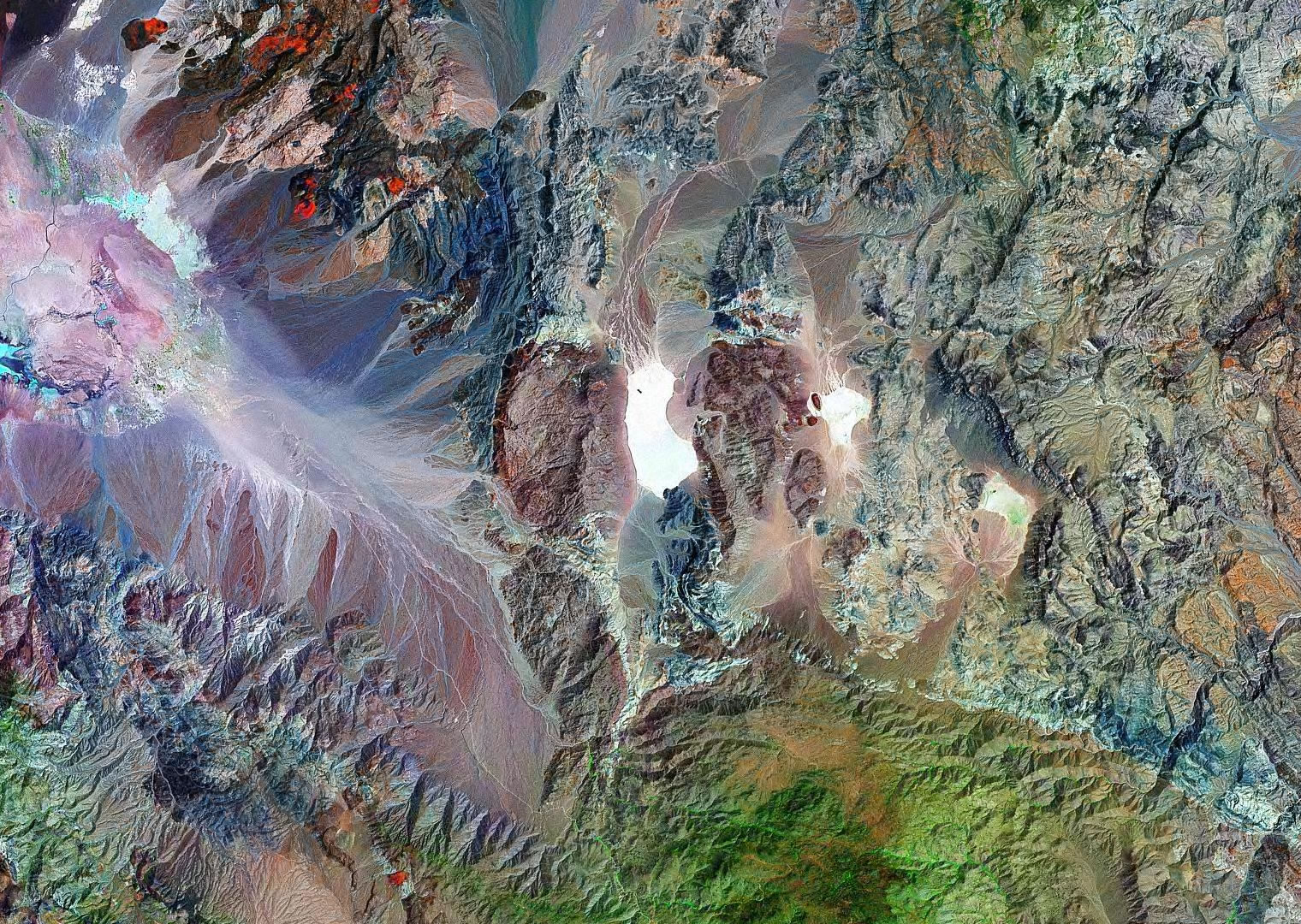
Landsat image of Racetrack Playa. It is the flat white area in the center of the image.(click for more detail)


Rocks of many sizes and shapes leave tracks across Racetrack Playa. © iStockphoto / David Choo.


Closer view of the sliding rock in the top image on this page. © iStockphoto / Skye Bajoul


Wednesday, 1 June 2011

Problems With "Flood" Geology

Problems With "Flood" Geology


A detailed compilation by Edward Babinski


Additional information on the failure of the creationist Genesis flood theory to explain the formation of the Grand Canyon is available in this web site


Flood geology bears all the signs of an idea that has not been properly thought through: its implications have never been carefully considered by its creationist exponents. For instance, conglomerate is a type of rock that looks kind of like a natural concrete. It has a matrix of sandstone or other fine-grained rock, but embedded in this are many rounded pebbles of various sizes, and even boulders...


The Institute for Creation Research implies that Noah's Flood was responsible for all the great concentrations of conglomerates throughout the world. But they nowhere face up to the great problems that this idea creates. One major difficulty is that many large deposits of conglomerate lie on top of great thicknesses - often several miles - of fine-grained sedimentary rock. The great conglomerate sea cliffs near Marseilles, for instance, are hundreds of feet high and contain boulders more than a foot in diameter. What purely natural processes would enable the Flood to deposit a thickness of several miles of fine-grained sediments first, and then place the boulder-laden conglomerates on top?


Have Flood geologists not heard the expression, to sink like a stone?


Another problem for them is the clean, sharp lines often found at the boundaries between geologic layers. (The layers which face upward often have fossil limpets or barnacles attached to them. This shows that those layers had time to harden into rock and attract rock-clinging shellfish before the next stratum was laid down, which is hardly likely to happen in a flood that laid down a mile-thick layer of unconsolidated sediments in less than a year.) These sharp boundary lines are particularly troublesome in the case of conglomerate rock atop underlying sandstone. Clearly, the lower layer must already have hardened into rock before the conglomerate was dumped on top, as otherwise the stones would have sunk into it. If one flood deposited both layers in quick succession, how could the underlying sandstone have hardened so fast?


Above all, there is the fact that the boulders inside conglomerate often contain fossils. How did they get there if, as Flood geologists assert, fossils are the remains of creatures that died in the Flood? And these boulders in conglomerate are nearly always rounded, as if they had been rolled around on a river or sea bed for long periods before being dumped in their last resting place. Of course, one can always argue that God specially created these rounded, fossil-laden boulders, and then miraculously caused the Flood to place them on top of the fine-grained deposits... [Alan Hayward, Creation and Evolution]


Oyster-like creatures are found from bottom to top of the geologic record- strange for slow moving bottom-dwellers. In chalk deposits a definite succession of different species of the same type of creature are found, separate and unmixed, at different levels... If they all once lived together, why do whales, seals, placoderms and oricthyosaurs not appear with modern fishes in fossilized marine Devonian environments?...


Why, if the flood took place rapidly, are sandstones nearly always void of fossils? Uniformitarians reasonably explain that, over a period, shells are oxidized and abraded out of existence by the sand - but is a year long flood enough time for that to happen?... [Michael Pitman, Adam and Evolution]


Flood geologists have proposed that hydraulic sorting explains the succession of fossils found in the geologic record. But such a proposal is clearly a non-starter. There are fossil ammonites, whose beautiful spiral shells contain buoyancy chambers, and are therefore very light - yet they're never found in the upper levels. And ammonoid species ranging in size from a fraction of an inch to several feet across are all found together in the same deposit...


The proposal that differential mobility explains the order found in the fossil record loses all credibility too. Why is there not a single human fossil below the topmost layer? Were there no inhabitants of the coastal plains who were overwhelmed in their sleep? No cripples or sick folk unable to flee to higher ground?


And why are the pterodactyl fossils all in the middle layers? You would think that at least one or two of them would have flapped their way to the hilltops...


Another proposal is that the Flood scooped up hundred-mile tracts of marine and land surfaces complete with their inhabitants, and then neatly arranged them into one-mile deep stacks - and in the right sequence, and without intermingling... Even if the Flood could have achieved such results in one place, it could not possibly have done so all over the world. The average thickness of fossil-bearing rock throughout the world is about a mile. Yet the precious layer of soil in and on which all life must live (except for swimming fishes and floating plants) is never more than a few feet thick. Did the Flood pick up that thin layer and with it produce sedimentary rock one mile thick? Because, if so, God must have miraculously multiplied that layer of soil, like the loaves and fishes of Galilee! [Alan Hayward, Creation and Evolution]


Even worse for the ecological zone stacking proposal of Flood geologists is the fact that it is often possible to trace such zones in the strata laterally (rather than vertically) over several kilometers and see them change from marine shelf, to beach, to terrestrial coastal plain, complete with rooted trees and coal. And there are sometimes volcanic ash beds which can be physically correlated over the same distance, confirming that the areas were synchronous - the ash bed was deposited by a single eruption (so the marine shelf and coastline at that lateral level existed at the same time in the past)...


The empty shells of ammonites, like that of the modern pearly nautilus, float after the death of the animal. Nautilus shells are found over much of the Pacific and Indian oceans because they are transported after death by water currents. They sink when they are damaged and fill with water. How floating shells could be effectively sorted by their hydrodynamic properties I do not know, but the predictions of a hydrodynamic sorting model are blatantly inconsistent with everything about the distribution of shelled cephalopods and other fossils...


The fossil succession of ammonoids having distinctive shell sutures is clear in the first appearance of each group...


Flood geologists must somehow assume that (for example) oysters could run faster than (for example) the many other types of clam found in the Paleozoic. Considering the fact that most oysters are cemented to the bottom, this seems a little unlikely. There are some clams in the Cretaceous, known as inoceraminds, which get up to a meter in size. Why they got sorted into the Cretaceous, and not much lower, whether due to hydrodynamic, ecological, or differential mobility, I have no idea.


There is a precise zonation of inoceramid clam species within the Cretaceous. Some are huge, some are small (fist-sized). They often co-occur. Even more paradoxically, for Flood geologists, is the fact that the juvenile (young) specimens, only a few centimeters in size and with much thinner shells, co-occur with the large, thick-shelled mature specimens of the same species. This is the normal situation in the fossil record...


In fact, most fossil brachiopods (clam-like animals) are found in life position (cemented to the bottom of solid rock, and after they were buried and the rock hardened, another layer of brachiopods grew atop them)...


The entire structure of Flood geology is nonscientific and is based directly on the creationists' religious beliefs. Neither are their ideas and proposals new. All can be found described in 19th century literature. They were wrong then,and are still wrong now, because of the geological evidence. Creationist Christian Bible-believing geologists of that period tossed flood geology models overboard for the sound scientific reason that such models were discovered to be completely inconsistent with the physical evidence. They did this despite their religious beliefs, because the evidence was so compelling. There is currently no scientific reason to bring Flood geology back. It has had its day in court. In fact, there is even more evidence falsifying it now than there was one hundred years ago. [Andrew Macrae]


Is the detailed record of successive fossil species, from simple to more complex, from general to special, from fish to man, entirely an artifact of Noah's Flood? Not one human being, or horse, or cow, or fox, or deer, or hippopotamus, or tortoise, or monkey, was so slow, or so stupid, or so crippled, that it lagged behind the others, and thus got caught down at the bottom of the hill. Not one! Conversely, there was not one dinosaur, or trilobite, or mammoth, that was lucky enough, or clever enough, or fast enough, to climb up to the top of the hill, and thus escape the fate of its fellows. Not one! And this is sound science? [Michael Ruse, Darwinism Defended: A Guide to the Evolution Controversies]


A flood strong enough to move all the sediments of the earth would tend to mix the different types of animals and plants into one big mishmash... The fossils are in the right order for evolution but not for hydraulic selection. The light animals refuse to stay in the shallow rocks, and the dense animals refuse to stay in the deep rocks, where they belong according to creationism. For instance, trilobites, light, fragile creatures resembling pill bugs, tend to be found only in the deepest rocks... The rocks show that each distinct species usually has its own horizon absolutely distinct from the horizons of other species of the same size, shape, and weight. [Christopher Gregory Weber, Common Creationist Attacks on Geology, Creation/Evolution, Issue 2, Fall 1980]


Flowering plants don't occur in the fossil record until early in the Cretaceous era. A forest of magnolias (a primitive tree) heading for the hills, only to be overwhelmed with the early mammals by the Flood, is unconvincing. [Robert J. Schadewald, Six Flood' Arguments Creationists Can't answer, Creation/Evolution, Issue 9, Summer 1982]


Flood geology doesn't explain why characteristic pollens and spores are found alongside animal fossils of each age (stratum), or why large, slow-moving mammals are invariably found in strata above flying pterodactyls and early birds like archaeopteryx. Flood geology also fails to explain the fossil pattern for trees. [Ken Nahigian]


Can creationists seriously believe that their Flood geology accounts for the numerous macro-evolutionary trends so well documented in the fossil record? Is it really possible that horses, humans, cows, and rats were true contemporaries of the primitive mammals known from Mesozoic deposits, but somehow only small noneutherian, apparently transitional (and small primitive eutherian mammals) managed to be buried beside the giants of the reptile world? [Laurie R. Godfrey]


If the worldwide sequence of fossils are the products of Noah's flood and its resultant fallout, why, then - at no place on this vast earth - do we find dinosaurs and large mammals in the same strata; why are trilobites never with mammals (not even marine mammals), but always in strata below? Surely some retarded elephant would be keeping company with dinosaurs, some valiant trilobite swimming hard for thirty-nine days and winning an exalted upper berth with mammals. [Stephen J. Gould, An Urchin in the Storm]


Why are whales and dolphins only found at high levels, while marine reptiles of similar size are found only much lower?... Why were not most of the birds exhausted far sooner, since perching places would have been hard to find in the raging Deluge?... Sardines and swordfish (teleostean fish), appeared in late Triassic times (200 million years ago) and show up in the fossil record more frequently with the passage of time. This contradicts predictions of Flood geology: these deep sea fish ought to be found in the lowest strata. Besides, these fish had no special hydraulic features and they were not especially fast swimmers. Yet all these lucky teleostean fish managed to resist the flood waters for a long time, while large numbers of speedy fish are buried beneath them. [Kitcher]


We might well ask whether the impressively huge carnivorous dinosaurs and other reptiles of the Mesozoic were weaker and less agile than the sheep and other grazing mammals that lay in the Cenozoic layers above them. Were the Mesozoic fish somehow less capable of avoiding burial in the hydraulic cataclysm than the Cenozoic corals and snails that are found above them in stratigraphic succession? We must conclude that the similarity between the known distribution of fossils and the prediction of the creationist model is insufficient to provide a basis for serious comparison. [Brian F. Glenister & Brian J. Witzke]


Remember that Flood geologists emphasize the violence of the Flood and its global scale. Dead plants and animals would have been very thoroughly mixed and transported large distances. How, then, could the sequence in which they settled out possibly be related to the original elevations of their habitats, or their running abilities? And why would man be a special case? His running and climbing ability is inferior to that of many animals. In any case, all the animals, including man, would have been killed long before the Flood finally ended, so that their ability to temporarily escape death (not burial) would have been irrelevant in the long run. [Willard Young, Fallacies of Creationism]


Creationists like to dismiss evolution as only a theory. My favorite rejoinder is that creationism isn't even a theory. When examined in the light of well-known and thoroughly researched scientific phenomena, creationist flood geology fails the most basic and simple test known to forensic science: bodies don't pile up the way creationists insist they must. [Walter F. Rowe, Bobbing for Dinosaurs: A Forensic Scientist Looks at the Genesis Flood, Creation/Evolution, Issue 28, Winter 1990-91]


Creationist Flood geologists are well aware of the second law of thermodynamics as it relates to the origin of life, but typically oblivious to it regarding the unlikely odds of so many fossils being segregated so perfectly in the geologic record... Like it or not, the association of certain types of fossils with certain strata, and the existence of trace fossils - like neatly laid eggs, tidy nests, rodent burrows and the footprints of air-breathing animals found deep within the strata - can only be explained by different types of animals and plants living at completely different times in the past. [Neil Slater]


The hydraulic engineer and co-author of The Genesis Flood, Henry Morris, not knowing that trilobites had a relatively light (non-dense) chitinous skeleton similar to that of crabs, has long said that trilobites were so dense they all sank to the lower layers during the Flood, and that's why they are found there. Actually they were much less dense than the clam-type mollusks which are found in great abundance in the higher layers of Mesozoic and Cenozoic rock systems; and both animal types lived in the same marine ecological zone (subtidal sea floor)...


Scleractinian corals are found in abundance almost worldwide, and more actual volume of their fossils is present on the earth than of any other group of Cenozoic animal fossils. So it is inconceivable that they would not have become mixed into the lower strata - in fact, all strata - of the earth's sedimentary cover if the Flood geology hypothesis were correct. By reading any of Henry Morris's descriptions of the convulsive activities which he visualizes as having occurred during the Flood one can see how completely illogical it is to assert that the Paleozoic strata were formed by the Flood, with these dense calcified Scleractinian corals somehow being held up and not allowed to sink into the lower layers of sediment. Moreover, Scleractinian corals are as dense as the more ancient corals, because they are composed of CaCO3, the same as those orders were... If Morris and the folks as his Institute for Creation Research are correct, then God would have had to have performed a very specialized miracle to sink the trilobites and hold the more dense clam-type molluscs floating in the water above them. A similar miracle would have had to have been performed to keep the Scleractinian corals suspended while two other orders of coral settled beneath them. A third miracle would have had to have been performed to keep thick layers of microscopic diatoms all over the earth rom mixing with the thick layers of microscopic radiolarians that settled in the strata beneath them! And so on and so forth. (I guess such specialized miracles were performed by God just to delude Christian geologists of the nineteenth century into rejecting the flood geology of their day? - Skip) [Daniel E. Wonderly, Neglect of Geologic Data: Sedimentary Strata compared with Young-Earth Creationist Writings]


There is a relative order to the fossilized species of plants found in the geologic record for which Flood Geology cannot account, unless you can imagine apple and orange trees with Nike sneakers on their roots, racing past the magnolias and primitive mammals, leaving the ginkgos back therewith the dinosaurs when the Flood waters began to rise. [Frank R. Zindler, Creationism on the Rocks, Dial-An-Atheist, Greatest Hits from Ohio]


Under the Flood geology hypothesis, one would expect that lowland-loving plants, such as cattails, willow trees and lily pads (which live on or near the surface of water) would have been buried long before those plants which favor higher and cooler areas, such as pine trees and other conifers. This, however, is not what we find in the fossil record. Instead, the evolutionarily primitive conifers appear much lower in the column than do modern angiosperms such as willow trees and oak trees. What a miraculous Flood to have sorted such an incalculably large number of plant remains (and also their fine pollen grains) in such a precise manner! What are the odds that one, big, violent Flood could have accomplished such a miracle? How did the oak and willow trees manage to get to the top of the sediment layer along with all those mobile mammals? Did the trees run for the high ground too? What about the many nesting sites that have been found for terrestrial dinosaurs? Are we to assume that these animals, panicked by the rising flood waters and the torrential rain and fleeing for the high ground, suddenly decided to stop and dig huge numbers of nests in the Flood sediments and lay eggs, which apparently had time to hatch before the Flood engulfed them?..


Apparently, Flood geologists would have us believe that the therapsid reptiles (who they assert were all contemporary and lived side by side) just happened to drown and become sorted by the Flood into a sequence which looks just like evolutionary descent; the forms with well-developed reptilian jaw joints and incipient mammalian joints just happened to be buried first, followed by those like Probainognathus with double jaw joints, while forms like the Morganucodonts, with functional mammalian joints and receding reptilian joints, just happened to climb a little higher or sink a little slower than the others (but not so high or so slow as the true mammals with no reptilian characteristics). Sea turtles violate every presumed sorting mechanism that Flood geologists have proposed; they live in the open deep sea, but are found high in the sediment layer-- above such terrestrial animals as amphibians and dinosaurs; they are big and heavy and sink rapidly upon death, but are found in the upper layers, above such lighter organisms as jellyfish and seaweeds; they are clumsy and slow on land, but apparently managed to run to the higher elevations before the Flood engulfed them (since they are found in the same sediment layers as such speedy animals as saber-toothed tigers and horses). Again, what are the odds that one big violent Flood could have sorted all the dead sea turtles in such an evolutionary fashion?


What are we going to do with all those fossil fragments? After all, most animal fossils come in bits and pieces. Are we to believe that a dinosaur knee had the same hydrodynamic sorting properties as a dinosaur claw, a dinosaur tooth, a dinosaur skull? Did baby dinosaurs have the same hydrodynamic sorting properties as the adults? Did bone fragments of baby dinosaurs, dinosaur egg shells, not to mention whole eggs, all have the same hydrodynamic sorting properties as the bones of adult dinosaurs? Odd, don't you think, that in those rare cases where dinosaur skin is preserved, it is found at the same level as the bare bones? Funny, that all these diverse bits and pieces should find their way to the same level of the geologic record, species by species. I would think that at least some dinosaur teeth would wind up with the trilobites, that a few hollow leg bones would be found near the top of the geologic column. This hydrodynamic sorting principle, as used by Henry Morris, is not just wrong statistically; it is totally FRAUDULENT. It is DISHONEST. It has no more explanatory power than the usual creationist miracles. Indeed, it is nothing more than a modern day miracle couched in scientific terminology. [Dave E. Matson, April 12, 1999]


In 1938 Harold Clark (a disciple of the Flood geologist, George Macready Price) was invited by a student to visit the oil fields of Oklahoma and northern Texas, where Mr. Clark saw with his own eyes why geologists believed as they did. Observations of deep drilling and conversations with practical geologists gave Clark a real shock that permanently erased any confidence he had left in Price's vision of a topsy-turvy fossil record. Clark wrote to Price: The rocks do lie in a much more definite sequence than we have ever allowed. The statements made in your book, The New Geology, do not harmonize with the conditions in the field. All over the Midwest the rocks lie in great sheets extending over hundreds of miles, in regular order. Thousands of well cores prove this. In East Texas alone are 25,000 deep wells. Probably well over 100,000 wells in the Midwest give data that has been studied and correlated. The science has become a very exact one. Millions of dollars are spent in drilling, with the paleontological findings of the company geologists taken as the basis for the work. The sequence of the microscopic fossils in the strata is remarkably uniform. The same sequence is found in America, Europe, and anywhere that detailed studies have been made. This oil geology has opened up the depths of the earth in a way that we never dreamed of twenty years ago. [Donald R. Prothero, SnakeHandlers and Flood Geologists: A Review Essay of The Creationists by Ronald L. Numbers, The Skeptic, Vol. 2, no.2, 19']


Many fossil bones found in terrestrial deposits show evidence of having been weathered for months and having been scavenged. In addition, many bones are preserved in calcareous fossil soils, i.e. the Badlands of North Dakota and the Karoo of South Africa. In marine deposits, the bones are frequently encrusted by organisms, bored by organisms, and have teeth marks from sharks and other scavengers. These are things that preclude the idea of rapid burial in a global flood. There exist almost innumerable examples in geological literature. [Paul V. Heinrich, heinrich@intersurf.com]


I'd suggest taking a look at the DNA of a specific animal, say a bat, as compared with the DNA of it's closest living relatives, then see when the bat and its nearest living relatives first appeared in the fossil record and show how near they are to one another in geological time. How could a FLOOD sort these creatures into the irrespectively close geological layers via their DNA? It took man a thousand years to come up with DNA comparison testing, but it took those muddy violent waters no time at all to sort species after species after species after species after species, all according to their DNA. Some Flood! -Edward T. Babinski (AKA, Skip Church)


The following anti-Flood arguments, based on questions of ethics, science, and history, are from my to-be-published manuscript, FUNNIER THAN HELL, OR, THE DAMNED SAY THE DAMNDEST THINGS, by Edward T. Babinski (AKA, SkipChurch)


NOAH, THE ARK, AND THE FLOOD


Was the god of the Hebrews so wise that he couldn't think of anything better than flooding the whole earth to kill those evil humans? That's like burning down the barn to kill rats, or using a sledgehammer to debug a rose bush. Even the world's dumbest surgeon doesn't use a guillotine to remove a mole on someone's neck. - Skip Church


I don't know who the worst sinners are on this planet, but I am quite sure that if a High Intelligence wanted to exterminate them, It would find a very precise method of locating each one separately. Carelessly murdering millions of innocent children and harmless old ladies, and dogs and cats, is absolutely and ineluctably to state that your idea of God is that of a cosmic imbecile. - Robert Anton Wilson


A God intelligent enough to design even a molecule, let alone a whole universe, would, if he-she-or-it went loony and decided to take up murder, still be intelligent enough to murder only the people he-she-or-it disliked. Accepting the dubious Warren Commission Report, even Lee Harvey Oswald only hit one innocent bystander (the governor). The early Old Testament God appears not only as crazy as Oswald but clumsier, stupider and generally less civilized. King Kong is as convincing a portrait of God as that given in the Old Testament. Trying to imagine Old Man JHVH (Yahweh/Jehovah) designing even a quark, let alone a molecule, is absurd; He would mess it up, go into a temper, and destroy five nearby cities to express his childish rage. - Robert Anton Wilson


Bible believers are constantly telling us how wicked the pre-Flood generation was. In those biblical movies you can practically feel the evil oozing out of those folks. By Jupiter, you can almost see it! But could they have done any wicked thing that hasn't been done just as wickedly by folks after the Flood? Conversely, if you examine the worst corner of the globe at its sorriest moment in history you will still find, by any reasonable standard of decency, a fair number of decent people. And, don't forget the children! Die-hard Bible believers answer curtly that the children were part of the cancer which had to be cut out! Their poor limited God had no choice, I suppose. He couldn't let them corrupt the purity of post-Flood generations. Purity as exhibited by Noah's drunken state after the flood, had to be preserved, no doubt, from the evil influence of pre-Flood children. And how horrible it would have been if a few pre-Flood children had survived and corrupted the folks of Sodom and Gomorrah. - Dave Matson, On Taking the Bible and Noah's Flood Literally


The Deluge: A punishment inflicted on the human race by an all-knowing God, who, through not having foreseen the wickedness of men, repented of having made them, and drowned them once for all to make them better - an act which, as we all know, was accompanied by the greatest success. - Voltaire, Dictionary of Theology


Why did God fill the world with his own children, knowing that he would have to destroy them? And why does this same God tell me how to raise my children when he had to drown his? - Robert Ingersoll, Some Mistakes of Moses


Somehow the Bible forgets to tell us that Noah and his family had every virus, bacteria, protozoa, flea, tick, lice, crab, bedbug, fluke, hookworm, tapeworm, roundworm, that feasts on human flesh. Not to mention that Noah would have had to have taken aboard only those pairs of animals carrying all the diseases and parasites that afflict those animals today. Sorry, the ark's full. Besides, you two unicorns look too healthy to be awarded a boarding pass. Maybe if you were running a fever and could show me some patches on your skin where your hair is falling out... - Skip Church


Noah and his family were saved...but they were not comfortable, for they were full of microbes...because enough microbes had to be saved to supply the future races of men with desolating diseases, and there were but eight persons on board to serve as hotels for them. - Mark Twain, Letters from the Earth


NOAH (A POEM)


It's Japheth who opens up, so to speak, the can of worms. Dad, there are thousands of species of worms! Who's going to dig for them? And oh, yes, how about the insects? Insects! Shem rebels at last, Dad, do we have to save insects? Noah, faithful servant, quotes the Word: Every living thing. But Dad, the cockroaches? Noah has all the best instincts of a minor bureaucrat - he is only following orders - the roaches go aboard. - Philip Appleman, Let There Be Light: Poems


Despite the world-wide catastrophic nature of the Genesis Flood, many land animals refused to drown. They were still walking around, building nests and burrows, and defecating on solid ground, right in the middle of the Flood! If you don't believe me, look at the geologic record where there are fossilized ant nests, termite nests, dinosaur nests, reptile nests (in the Chinle Formation of the Petrified National Forest), bird nests (of a relative of the flamingo in the Green river formation in Wyoming), fragile wasp cocoons, cells from bees nests, complex rodent burrows, animal dung in its original position of deposition as it hardened on dry solid ground, and tracks left by land-dwelling insects and vertebrates as they walked around. Such evidence of living land-dwellers has been found at all different levels of the geological strata, as if the Flood didn't do its drowning job very well. - Skip Church


EXPERIMENT FOR NOAH ENTHUSIASTS:


1. Take one of your favorite household potted plants.


2. Immerse it in water, or just water it like hell, for 40 days and nights. (For full Biblical verisimilitude, try doing this for a full year.)


3. Observe rotted dead plant.


As a botanist I get extremely disgruntled when reading about Noah. You see, God appears only to be interested in animals. Noah received no instructions to take on board any plants (by plants I mean angiosperms, gymnosperms, pteridiophytes and bryophytes). Talk about shortsightedness. Could this be the root cause for Zoology always being more popular than botany? Dear Flood supporters, pray tell how did plants survive the Flood? Waiting in anticipation. - M. (Matto), University of Stellenbosch


After a year at sea, what is the likelihood that any surviving plant seeds would be dropped in an area where the temperature, rainfall, soil, and light would be suitable for their growth?... Assuming some seeds did reach a survivable spot, how long would their flowers have to wait before the birds and insects arrived from Mount Ararat to cross-pollinate them?...


Isaac Asimov observes that the ancient Hebrews did not regard plants as alive in the same sense animals are; therefore they no doubt had no problem picturing olive trees enduring a year's drowning and sprouting immediately afterward. (Remember the tale of the dove that returned to Noah's ark with a live olive branch in its mouth?) Today's fundamentalists should have learned some botany since then, but they still carry on about the hardiness of olives... Creationists need to soak seeds in muddy salty water for a year and then plant them in unconsolidated, briny silt in an unfavorable climate without insect or avian pollinators to see what happens. Have their mathematicians, so skilled at calculating improbabilities for protein formation, ever determined the odds of plant survival? - Robert A. Moore, The Impossible Voyage of Noah's Ark, Creation/Evolution, Issue 11, Winter 1983


The Flood, having saturated the earth with salty water, retreats. The land dries out, but the soil remains tainted by its saline past. Worms can not live in it. Plants can not grow in it. The earth dies. - Matt Giwer, talk.origins newsgroup, April 30, 1996


With the land bare of plants, what did all the herbivores eat after they disembarked from Noah's ark? Oh wait, I forgot, they didn't have time to eat; they were too busy fleeing from the hungry carnivores that disembarked after them. - Skip Church


A SPECIAL CONTINGENT OF MARSUPIALS BEAT THE MAMMALS TO AUSTRALIA?


The marsupial population of Australia contains animals found nowhere else on earth - not even in fossil form. Are we to suppose that those marsupials managed to travel from the landing place of Noah's ark to Australia? What a long perilous post-Flood journey. I guess God guided them. But you don't hear about that miracle in the Bible. Why not? It's at least as good as the story about God herding the Israelites through the desert, only these marsupials were herded through a denuded post-Flood earth undergoing cataclysms galore. This menagerie of wombats and koalas, bandicoots and kangaroos (not to mention the flightless moa and kiwi birds of New Zealand) had to keep ahead of lions-'n-tigers-'n-bears all the way to Indonesia, and then - although the superior placental mammals could not manage it - reach the continent of Australia. As if this were not mind-boggling enough, it turns out that the types of marsupials that made it to Australia just happened to form an ensemble able to fill all the ecological niches available! Thus, there were marsupial moles, ant-eaters, mice, grazers, carnivores, frugivores, etc. - not one of which can be found anywhere else in the world. If this highly diversified marsupial population evolved from one or a few primitive generalized marsupials that reached Australia millions of years before it separated from Indonesia (and before mammals had evolved), then this peculiar situation is understandable. But if all these creatures had to journey from Turkey to Australia as an ensemble, it is incredible beyond computation. (Note: Molecular biology and anatomy both demonstrate that, of living marsupial groups, koalas are most closely related to wombats. And both the living species and fossilized remains of koalas and wombats are found only in Australia. - Skip Church)


Frank Zindler, The Kiwi Question, American Atheist, May 1988:


Did such fragile creatures as the platypus and the blind marsupial mole race across the land bridge to Australia quicker than the Malaysian tigers and other robust placentals? - Robert A. Moore, The Impossible Voyage of Noah's Ark


Can I suggest that there was a large sign, somewhere in South-East Java, reading something like: Celestial Quarantine Zone: *NO* placental land mammals, with the exception of murine rodents and the genetic precursors of Canis familiaris dingo, may be transported or allowed to wander past this point. American marsupial species must take the Bering Straits route. Maps available at the quarantine station office. (Office hours 9:00 A.M. - 5:00 P.M.) - Peter Lamb, talk.origins newsgroup, April 30, 1996


The authors of the Bible shortened and simplified the original story of Noah's ark for maximum dramatic effect. In the original version there were three arks. The first ark carried Noah and the mammals. It landed in Turkey. The second ark carried the dinosaurs. As we all know, it did not prove seaworthy. And the third ark? It carried an ensemble of marsupials and flightless birds, and it came to rest in Australia, the one continent containing the fossils of their ancestors, like fossilized moas, kangaroos and kiwis. What are the odds?! - Skip Church


The Gila monster and Mexican bearded lizard (the only members of family Helodermatidae), disembarked from the ark, but chose not to stay in the inconvenient Asian deserts. Instead, they journeyed through Siberia and across the Bering land bridge, Alaska, and Canada to arrive in the American Southwest, accomplishing this feat during the same Ice Age that creationists say decimated the dinosaurs and buried mammoths! - Robert A. Moore, The Impossible Voyage of Noah's Ark


Sloths are so slothful that moss grows on their fur. When they move, which is not often, it takes them three and a half hours to walk a mile. Their metabolism is so low that they lounge in trees and soak up the sun's rays for the greater part of each day. When the two sloths from Noah's ark disembarked, I wonder how they reached the jungles of South America? Did they walk across Asia, then through the cold wilderness of northern Siberia, cross to Alaska, then walk down to South America to get warm again? All in record breaking time for sloths. What did they eat on their journey? What a book of adventures that would make, with the cataclysmic after-effects of the Flood hounding their every step. I wish that story was in the Bible. - Skip Church


God made all the animals in a single day; he could have swept them all away in the flood and re-created them in one day when they were again needed. Therefore it was an odd idea to save specimens of them for eleven months in the ark, whilst aware that eight persons could not feed or water them by any human possibility. If they were to be preserved by miracle, the ark was not necessary - to let them swim would have answered the purpose and been more indubitably miraculous. - Mark Twain, God of the Bible vs. God of the Present Day


We do not see the name of Noah or of Adam in any of the ancient dynasties of Egypt; they are not to be found among the Babylonians and Sumerians. We cannot comprehend how the father of all nations has so long been unknown, not until the time when the Jewish books began to be known in Alexandria and were translated into Greek under one of the Ptolemies. In the natural course of things Adam's name should have been carried from mouth to mouth to the farthest corners of the earth. I will venture to affirm that it has required a miracle thus to shut the eyes and ears of all nations - to destroy every monument, every memorial of their first father. What would the Roman philosopher and orator, Cicero, have thought, if a poor Jew, while selling him balm, had said, We are all descended from one father, named Adam. Cicero would doubtless have inquired about the great monuments, the indisputable testimonies which Noah and his children had left of our common father. After your so-called Deluge, he would have said, the whole world would have resounded with the names of Adam and Noah, one the father, the other the restorer of every race. These names would have been in every mouth as soon as men could speak, on every parchment as soon as they could write, on the door of every house as soon as they could build, on every temple, on every statue. You mean to tell us that you knew so great a secret, yet concealed it from us? Every people has attributed to itself some imaginary origin, yet none has approached the true one. - Voltaire, Philosophical Dictionary, entry under Adam


Wilfred A. Elders,


Riverside, CA, USA

http://www.fsteiger.com/flood-report.html